顯示具有 FDC 標籤的文章。 顯示所有文章

2010年7月27日 星期二

FDC - 100th anniversary of Canadian Girl Guides


Since 1910, Girl Guides of Canada has been a trailblazing movement advocating for girl and women, providing them with opportunities to discover new interests and develop leader skills. One hundred years agi, the first Canadian Guiding unit was formed in St. Catharines, Ontario, and today there are units in every province and territory.

Throughout its history, Guiding has prepared girls to meet challenges they face through a variety of activities including camping and outdoor advanture. Today, girls can learn about global and cultural awareness, career ecploration, science and technology, and the arts. They work on environmental projects and explore important issues, such as cyber-bullying, self- esteem and body image. Trough these activities, they develop the skills needed to speak out and take action on issues that are important to them. Guiding enables girls to be confident, courageous and resourceful , and to make a difference in the world

2010年7月25日 星期日

China- Interrelated Locality Cover (2010-18J) and FDC - China Maritime Day


Interrelated Locality Cover , sent from Liuhe, Taicang, Jiangsu Province.

With the envelope used at The Office to commemorate Zheng He at Taicang City.

Zheng He (simplified Chinese: 郑和; traditional Chinese: 鄭和; pinyin: Zhèng Hé; Wade-Giles: Cheng Ho; Birth name: 馬和 Ma He. Also known as: 馬三寶 / 马三宝; pinyin: Mǎ Sānbǎo, Arabic/Persian name: حاجی محمود شمس Hajji Mahmud Shams) (1371–1435), was a Hui Chinese mariner, explorer, diplomat and fleet admiral, who commanded voyages to Southeast Asia, South Asia, and East Africa, collectively referred to as the travels of "Eunuch Sanbao to the Western Ocean" (Chinese: 三保太監下西洋) or "Zheng He to the Western Ocean", from 1405 to 1433.


FDC sent from the heart of China, Zhongnanhai, where the office of headquarters for Chinese Communist Party and the state Council of P.R China

2010年7月12日 星期一

Korea - 60th anniversary of Korean War


60 years since the Korean War..

You can still find the mark of that war on the Korean Land

In the North, people called that "The Liberation War on fatherland" and they claimed victory on the war.

War is so bad, I hope war won't broken out again, as thousands of Chinese, Korean, American teens loss their life in that horrible war...

2010年7月11日 星期日

Slovakia - Interrelated Locality Cover - Castle Betliar.


Betliar
(Hungarian: Betlér) is a village and municipality in the Rožňava District in the Košice Region of eastern Slovakia, known for its manor house built by the Andrássy family.

  • Location: Slovak republic, Betliar is situated in South-East part of Slovenské rudohorie in valley of river Slaná, 5 km north of town Rožňava.
  • Height above sea level: 311 meters.
Number of inhabitants: about one thousand


Thank you thank you very much to my friend sending this cover. Of course this is a FDC... But he sent it just at the castle Betliar... this makes the cover more precious than those normal FDCs!

2010年6月29日 星期二

Taiwan - Taiwan Sculpture Postage Stamp FDC


Over the course of history, Taiwan sculpture has evolved as a result of various factors—both domestic and foreign—involving the inheritance, convergence, and fusion of different cultural elements. To introduce the beauty of Taiwan sculpture, Chunghwa Post will issue a souvenir sheet on “Water Buffaloes” by Huang Tu-shui. The souvenir sheet, which has a denomination of NT$25, is designed by Delta Design Corporation and printed and embossed in color offset by Cardon Enterprise Co., Ltd. The sheet is embossed and will be released on June 22, 2010.

Huang Tu-shui (1895-1930) was Taiwan’s first contemporary sculptor and a pioneer in fusing western and traditional sculptural elements. “Water Buffaloes,” one of Huang’s masterpieces and his most representative work, is featured on this miniature sheet. “Water Buffaloes” depicts a scene in a banana grove at the height of the summer: a refreshing breeze lightly sways the banana leaves as five water buffaloes mill about in a pasture. There are two naked shepherd boys: one on the back of a water buffalo, with a bamboo rod in hand and a bamboo hat on the tip of the rod, and another standing in front of the calf, caressing it with his

hands. There is another boy, who is wearing a bamboo hat who is wearing a bamboo hat and sitting on the back of a buffalo. The air and posture of the boy touching the calf gives the work a sense of peace and stability, and the intermingling of the buffaloes provides a sense of balance. The piece vividly records a simple rural scene characteristic of early Taiwan. The design on the margins of the sheet features key parts of the sculpture, which are blown up and given a lighter hue. The sculpture is now on display in the Guangfu Auditorium of Zhongshan Hall in Taipei City.

2010年6月28日 星期一

Poland - 750 YEARS OF THE TOWN TCZEW


Tczew [tt​͡ʂɛf] (German: About this sound Dirschau ; Kashubian: Dërszewò) is a town on the Vistula River in Eastern Pomerania, Kociewie, northern Poland with 60,279 inhabitants (June 2009). It is an important railway junction with a classification yard dating to the Prussian Eastern Railway (German: Preußische Ostbahn). The city is known for its attractive old town and the Vistula Bridge, or Bridge of Tczew, damaged during World War II.

It is the capital of Tczew County in Pomeranian Voivodeship since 1999, and was previously a town in Gdańsk Voivodeship (1975–1998).


From Wikipedia

2010年6月27日 星期日

Hong Kong- Interrelated Locality Cover "Characteristic Streets in Hong Kong"

Hong Kong, a dynamic metropolis in every sense, is also a place brimming with unique local culture. This set of special stamps features six characteristic streets in Hong Kong to highlight the fascinating confluence of old and new, East and West in this city.

The set contains six stamps of different designs in three denominations.

Pottinger Street ($1.40) - The street was originally built from Queen's Road Central up to Hollywood Road. Because of its steep slope, the street was paved entirely with stone slabs, forming steps in an undulating pattern to make it easy for people to go up and down and to drain away stormwater. It is hence also called "Stone Slab Street".

* This cover was sent from the nearest post office related to the stamp : Wyndham Street (WYN)

Nathan Road ($1.40) - Stretching from Tsim Sha Tsui in the south all the way up to Boundary Street in Mong Kok, Nathan Road is one of the busiest streets in Hong Kong. It runs through the hustling and bustling Yau Tsim Mong District, lit up like a kaleidoscope by neon signs of shops, hotels, shopping arcades and restaurants along the way.

* This cover was sent from the nearest post office related to the stamp : Mongkok (MGK)

Hollywood Road ($2.40) - Alias "Antique Street", Hollywood Road is lined with antique shops that lend an air of nostalgic elegance. In this treasure trove for antique lovers, a wide range of thrilling items covering ceramics and jade, silk and embroidery, blackwood furniture, paintings and calligraphy are waiting for discerning buyers.

* This cover was sent from the nearest post office related to the stamp : Sheung Wan (SWN)

Temple Street ($2.40) - For a real taste of Hong Kong culture, there is no better place than Temple Street, the street named after Tin Hau Temple in Yau Ma Tei. Dubbed "People's Night Market" for its all-time bargains, Temple Street comes alive when the city lights up at dusk. Flocks of visitors linger around open-air stalls offering inexpensive goods, local culinary delights or fortune-telling, and they also enjoy performances of Chinese opera.

* This cover was sent from the nearest post office related to the stamp : Kowloon Central (KCL)

Des Voeux Road West ($3) - Our famous "Dried Seafood Street", Des Voeux Road West is a traditional marketplace for ginseng products and herbs as well as dried seafood. Clustered with shops selling products such as dried abalone, sea cucumber, shark fin and fish maw as well as Chinese herbal medicines and tonics, the street swarms with locals and visitors shopping for festive goodies when the Lunar New Year is drawing near.

* This cover was sent from the nearest post office related to the stamp : Sai Ying Pun (SYP)

Stanley Market ($3) - Encompassing Stanley New Street, Stanley Market Road and Stanley Main Street, Stanley Market is a popular tourist attraction in Southern District on Hong Kong Island. Apart from an interesting array of shops and stalls selling clothing and accessories, Chinese paintings and calligraphy, handicrafts and local souvenirs, the place is dotted with bars and restaurants offering a fine selection of world cuisines, making it an ideal choice for leisure travel.

* This cover was sent from the nearest post office related to the stamp : Stanley (STY)

2010年6月26日 星期六

Russia - Historical-cultural heritage of Russia. Valaam.


Valaam, also known historically by the Finnish name Valamo, is an archipelago in the northern portion of Lake Ladoga, lying within the Republic of Karelia, Russian Federation. The total area of its more than 50 islands is 36 km². The largest island is also called Valaam. It is best known as the site of the 14th century Valaam Monastery and for its natural beauty.[1] In the 12th century, the islands were a part of the Novgorod Republic. In the 17th century, they were captured by Sweden during the Time of Troubles, but Russia reconquered them less than a century later. When the Grand Duchy of Finland was set up in the early 19th century as an autonomous part of the Russian Empire, Alexander I of Russia made Valaam a part of Finland. In 1917, Valaam became a part of newly independent Finland, but it was acquired by the USSR after the Winter War and Continuation War.

The name of the island is from the Finno-Ugric word valamo, which means the high, mountain, ground. The climate and natural history of the island are unique because of its position on Lake Ladoga. Spring begins at the end of March and a typical summer on Valaam consists of 30-35 sunny days, which is more than on the mainland. The average temperature in July is 17 °C. The winter and snow arrive in early December. In the middle of February the ice road to the nearest city of Sortavala (42 km) is traversable. The average temperature of February is minus 8 °C.

More than 480 species of the plants grow on the island, many of which have been cultivated by monks. The island is covered by coniferous woods, about 65% of which are pine. The island was visited repeatedly by emperors Alexander I, Alexander II, and other members of the imperial family. Other famous visitors include Tchaikovsky and Mendeleyev.

The island is permanently inhabited by monks and families. In 1999, there were about 600 residents on the main island; including army service personnel, restoration workers, guides and monks.[2] There is a kindergarten, an arts and sports venue, a school and a medical center. The community on Valaam at the moment has no official administrative status. The lay inhabitants, (Валаамцы — Valaamtsy), want their settlement to receive the official status of a rural settlement that will enable them to participate in municipal elections. However the leaders of the monastery are opposed to this.

During the summer, the main island can be reached by tour boats which leave St. Petersburg at night and arrive at the island the following morning.[3]

2010年6月25日 星期五

Russia - The 500th anniversary of birth of Ivan Feodorov.

Russia - The 300th anniversary of Cyrillic alphabet – first civil alphabet.


The Cyrillic script (pronounced /sɨˈrɪlɪk/, Bulgarian: Кирилица [kɨˈrɪlɪtsa], Russian: Кири́ллица [kʲɪˈrʲilʲɪʦə]) is an alphabet developed in the 9th century[1] in Bulgaria, and used in the Slavic national languages of Belarusian, Bosnian, Bulgarian, Russian, Rusyn, Serbian, Macedonian, Montenegrin and Ukrainian, and in the non-Slavic languages of Moldovan, Kazakh, Uzbek, Kyrgyz, Tajik, Tuvan, and Mongolian. It also was used in past languages of Eastern Europe, the Caucasus, and Siberia.

The Cyrillic alphabet is also known as azbuka, derived from the old names of the first two letters of most variant Cyrillic alphabets. With the accession of Bulgaria to the European Union on 1 January 2007, Cyrillic became the third official alphabet of the European Union, following the Latin and Greek alphabets.

Cyrillic is one of the two alphabets (together with Glagolitic) used in the Church Slavonic language, especially the Old Church Slavonic variant (see Early Cyrillic alphabet). Hence, expressions such as “И is the tenth letter of the Cyrillic alphabet” typically denote that meaning; moreover, not every Cyrillic-based language uses every letter of the alphabet.


` From Wikipedia

2010年6月5日 星期六

Russia - Issue by “Europa” programme. Children' books

Russia- The XXI Olympic Winter Games.


The XXI Olympic Winter Games will be held on February 12-28, 2010, in Vancouver, BC, Canada. The emblem of the Games has become a stylized figure of inukshuk - stone sculpture in the form of human being. The emblem was given the name “Ilanaak”, which from the local Indian dialect means "friend".


The stamp with the snowflake background depicts a stylized medal with the logo XXI Olympic Winter Games.

Russia- 50th anniversary of Peoples’ Friendship University of Russia.


Peoples' Friendship University of Russia - one of the largest and most prestigious universities of Moscow, it has a status of the University of the Federal Level, one of the five best universities of Russia. Peoples' Friendship University was established by the Resolution of the USSR Council of Ministers on February 5, 1960, and on February 5, 1992 according to the Government's decision it was renamed into Peoples’ Friendship University of Russia. The special feature of the PFUR is its multinationality: among students, graduate students and trainees – there are representatives of 450 nationalities and ethnic groups from more than 131 countries.

Russia - The 150th anniversary of birth of Anton Chekhov (1860-1904).


Anton Pavlovich Chekhov , was a Russian short story writer,playwright and physician, considered to be one of the greatest short-story writers in the history of world literature.His career as a dramatist produced four classics and his best short stories are held in high esteem by writers and critics. Chekhov practised as a doctor throughout most of his literary career: "Medicine is my lawful wife", he once said, "and literature is my mistress."

Russia The 100th anniversary of birth of Anatoly Serov (1910-1939)


Anatoly Serov
, Hero of the Soviet Union, entitled with 2 times Orders of Red Banner, order of Lenin.

Anatoly Serov was born on 20 March 1910 in Vorontsovka in the North Urals region (according to other sources he was born on 2 April 1910).

He enlisted into the Red Army in 1929 and joined the Bolshevik Party in 1931.

He attended the Orenburg Military Air College, from which he graduated on 17 December 1931. Initially he served in the Leningrad area, but was then sent to the Far East. He worked as a test pilot until spring 1937.

Serov fought in the Spanish Civil War and he arrived probably in the country in May-June 1937. During this conflict he flew under the name `Rodrigo Mateu`. Totally he claimed eight victories in 48 fights. In 1938 he returned to the URSS.

For his bravery in Spain he was decorated with two Order of Red Banner, a Gold Star of Hero of the Soviet Union along with an Order of Lenin and promoted to colonel. Later in 1938 he was promoted to Chief of the Air Inspectorate of the Soviet Union. Next year he was promoted to the rank of General Leitenant. Anatoly died in an air crash on 11th of May 1939, during a long-range training flight in UTI-4 trainer, together with the female pilot Major Polina Osipenko. They were both buried in the walls of Kremlin.

To remember A. K. Serov, his name was given to a little industrial town in the Sverdlovsk region, a Flying School at Bataisk, a Technical School and other Soviet State institutes.

The stamp represents the portrait of A. Serov and aircraft I-15.

2010年4月10日 星期六

Russia- V.S. Grizodubova. 100th birth anniversary FDC.


Valentina Stepanovna Grizodubova, Hero of the Soviet Union, Hero of Socialist Labour, entitled with 2 times Orders of Lenin, order of October Revolution, 1st class of Order of the Great Patriotic War, Order of the Red Banner of Labour, Order of Red Star and Various other awards.

She was one of the first Soviet Woman Pilots, On September 24-25, 1938 as the commander of the crew she completed the flight of the Rodina (Russian for "Motherland"), the ANT-37 airplane, setting an international women's record for a straight-line distance flight. Since March 1942 she took part in the Great Patriotic War.

In the 1940s she served as the sole female member of the "Extraordinary State Commission for the Establishment and Investigation of the Crimes of the Fascist German Invaders and Their Accomplices, and of the Damage They Caused to Citizens, Collective Farms, Public Organizations, State Enterprises, and Institutions of the USSR" (Chrezvychainaia gosudarstvennaia komissiia or Чрезвычайная Государственная Комиссия; ChGK), appointed to investigate Nazi war crimes in the Soviet Union.

Grizodubova was the Honorary Citizen of Penza. There is a monument to her in Moscow.

2010年4月8日 星期四

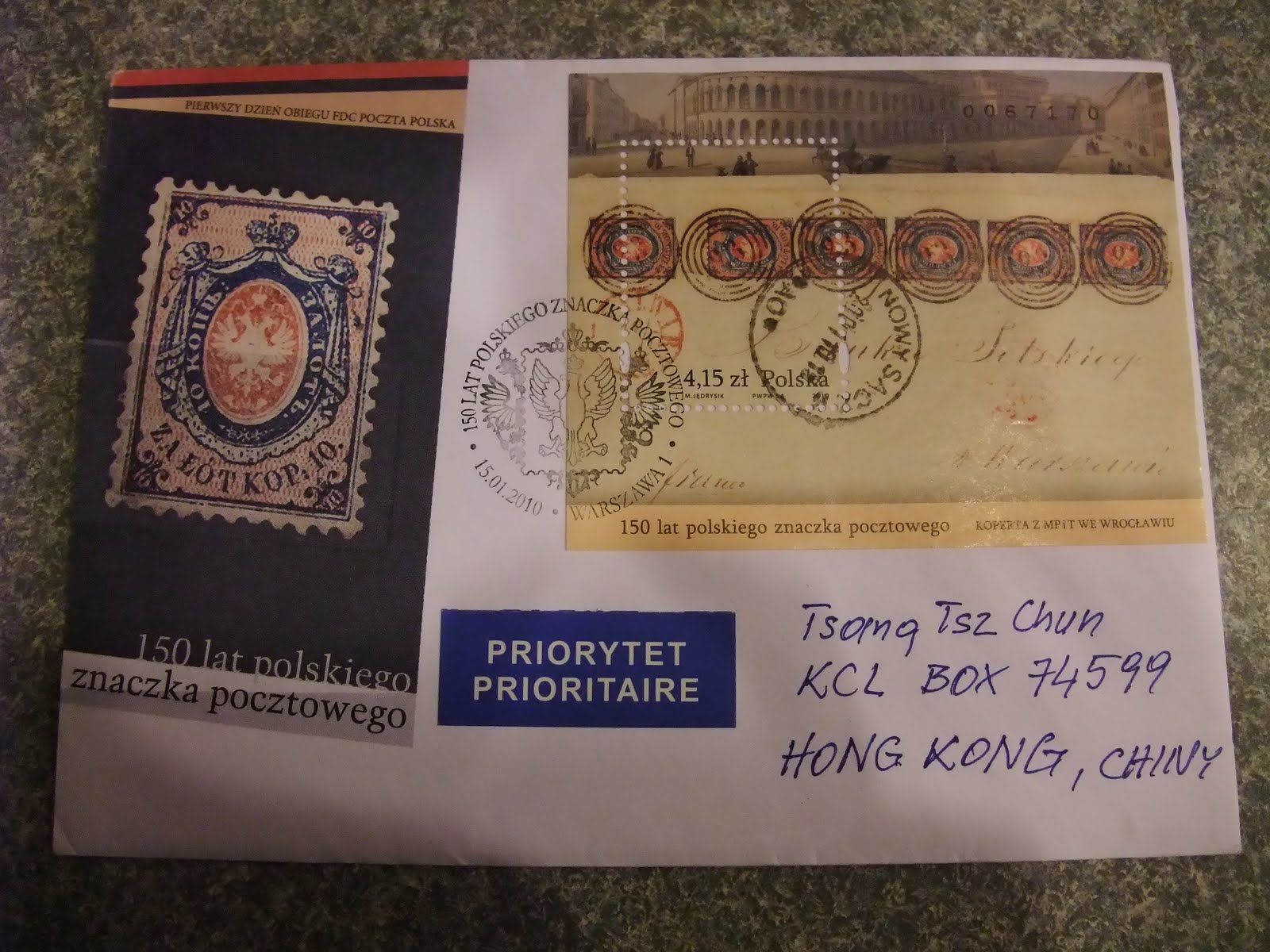
150 YEARS OF POLISH POST STAMP -- FDC.


This is a survey of the postage stamps and postal history of Poland. Although a postal service existed in Poland from 1558 postal markings were first introduced in 1764. The three partitions of Poland in 1772, 1793 and 1795 saw the independent nation of Poland disappear.

The first Polish stamp was issued for the Congress Kingdom on 1 January 1860 (Gregorian calendar). Because January 1 was a Sunday the stamp was not actually available until the following day. The design was similar to the contemporary Russian stamps with the arms of the Congress Kingdom in the centre. The engraving was done by the Polish Bank engraver Henryk Mejer. The drawings he used were found in the archives at St Petersburg but the name of the artist remains unknown. The stamps were printed by the government printers in Warsaw on the orders of the Congress Kingdom postal service. The letterpress machine used was invented by Izrael Abraham Staffel (1814-1884) for printing in two colours. The machine was capable of printing 1,000 sheets per hour and it had a counting device which ensured an accurate count. Apart from these facts very little more is known about the machine.[9]

The printing was done without consultation of the Russian postal service. The regional office in St Petersburg only approved afterwards, on 4 March 1860 (Gregorian calendar). These stamps could only be used within the Congress Kingdom and to Russia. Letters to other countries had to be paid for in cash and unstamped. It is believed that some three million of these stamps were printed. When the stamps were withdrawn from use on 1 April 1865 (Gregorian calendar) a total of 208,515 stamps were destroyed. Russian stamps had to be used from that day onwards.[10]

In 1915 the Congress Kingdom was occupied by the Central Powers.


*Thank you very much Andrzej!

2010年3月26日 星期五

China- Interrelated Locality Cover (2010-7T) - Dwelling in the Fuchun Mountains


China- Interrelated Locality Cover (2010-7T) - Dwelling in the Fuchun Mountains sent with the envelope of Museum of Zhejiang province., where this painting was preserved and sent at the nearest post office from the museum.

From Wiki

"Dwelling in the Fuchun Mountains (《富春山居圖卷》) is the magnum opus and one of the few surviving works by the Yuan Dynasty painter Huang Gongwang (1269 - 1354). Painted between 1348 and 1350, the Chinese landscape painting was burnt into two pieces during the reign of the Shunzhi Emperor (1644 - 1661) in Qing Dynasty. Today, one piece is kept in the Zhejiang Provincial Museum in Hangzhou, China; while the other is kept in the National Palace Museum in Taipei, Taiwan. The entire painting combined would measure 691.3 cm in length."

Some can discover that there are only 4 stamps of the set have been used on the envelope and 2 still missing. This is due to the reason of Postage. The accurate postage used is one of the very important rules for Chinese envelope collectors.


2010年3月20日 星期六

From Germany


A nice FDC from Germany

A piece of stamp "Serie »Deutsche Malerei«: Angelika Kauffmann - Die verlassene Ariadne" was sticken on the cover. ( Series of German Paintings: Angelika Kauffmann- painter for Neoclassicism)


Hong Kong 2010 New issue - Mainland Scenery Series No.9: Fujian Tulou


Hongkong Post's Stamp Sheetlets on Mainland Scenery delight the eyes with magnificent landscapes and majestic architecture. The ninth series presents Fujian Tulou, the world's unique mega rammed earth housing structures for mountain dwellers.

A sparkling gem in Chinese culture, Fujian Tulou is known for its long history, massive scale and intricate structure. It is also known as "Hakka Tulou" as most tulou (literally meaning earthen houses) were built by the Hakka people of Fujian Province. Raw earth, the primary construction material, is mixed with sand, lime, wood strips and the like. The mixture is then rubbed, pounded and compressed. Constructed with these reinforced materials, tulou are well ventilated, naturally lit, wind sheltered and quakeproof. The baked tile roofs are exceptionally durable.

If classified by architectural styles, Fujian Tulou mainly consist of round house, square house and "Five-Phoenix" house, with rotunda being the dominant form. The ingeniously built structures sit comfortably on narrow plains in the mountains. Their sophisticated design effectively meets the needs of clan communities, providing defence and security.

Officially inscribed on the World Heritage List on 6 July 2008, Fujian Tulou comprises 46 buildings scattered in ten sites in three counties. They are the Chuxi Cluster, Hongkeng Cluster, Gaobei Cluster, Yanxiang Lou and Zhenfu Lou in Yongding County; Tianluokeng Cluster, Hekeng Cluster, Huaiyuan Lou and Hegui Lou in Nanjing County; and Dadi Cluster in Hua'an County.

The sheetlet depicts the five tulou of the Tianluokeng Cluster. The square Buyun Lou in the middle is surrounded by three rotundas, namely Hechang Lou, Ruiyun Lou and Zhenchang Lou, and the oval Wenchang Lou. The stamp features Chengqi Lou of the Gaobei Cluster, renowned as the "King of Tulou". With its imposing grandeur combined with age-old simplicity, Chengqi Lou blends in perfectly with nature, exemplifying the poetic charm of mountain living.

Stamp products include stamp sheetlet, presentation pack and prestige stamp sheetlet box gift set. Serviced first day cover are also available at the philatelic offices on the issue day only.


From: http://www.hongkongpoststamps.com/eng/stamps/latest_stamp_issues/2010/20100304a/introduction.htm